
UC-MSC
Wharton’s JELLY THERAPY
Understanding the science before considering treatment –
A physician-guided introduction to the science, evidence, safety and limitations of UC-MSC therapy.
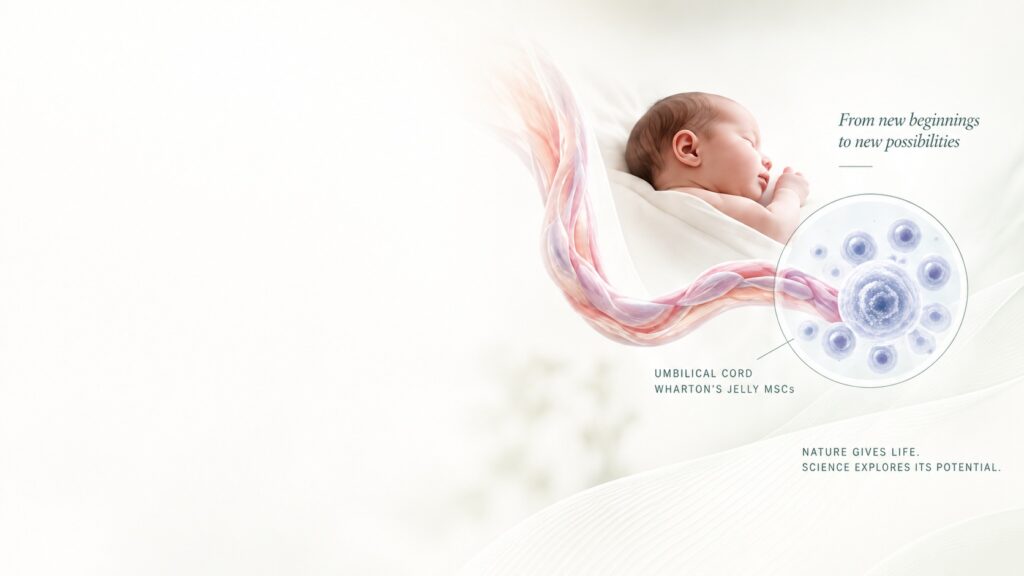
Umbilical cord-derived mesenchymal stromal cells (UC-MSCs) are cells obtained from Wharton’s Jelly, the soft, gelatinous connective tissue surrounding the blood vessels of the umbilical cord.
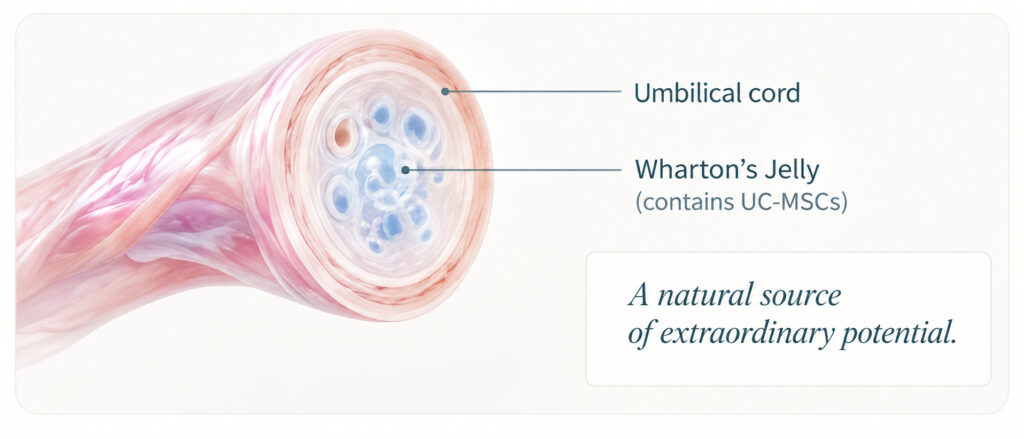
Rather than simply acting as replacement cells, UC-MSCs are being studied for their ability to communicate with immune cells and surrounding tissues through biological signals. Research is exploring their potential roles in immune modulation, regulation of inflammatory signaling, tissue-support mechanisms and repair-related processes.
Because they come from perinatal tissue, UC-MSCs are also of interest for their growth and biological characteristics.
Read the Patient Guide: What are MSCs and Wharton’s Jelly? →
UC-MSCs are thought to act primarily through biological signaling rather than by permanently replacing damaged cells. They interact with immune cells and release signaling molecules that may influence inflammation, tissue protection, repair, and remodeling.

May interact with immune cells and help regulate excessive or dysregulated immune responses.

May influence inflammatory pathways in response to signals from the surrounding tissue environment.

Release cytokines, growth factors and extracellular vesicles that communicate with nearby cells.

May support the body’s own cellular repair and tissue-protective processes.

Being studied for effects on signaling involved in extracellular-matrix remodeling and fibrosis.
A signaling effect—not simply cell replacement
UC-MSCs are not thought to work mainly by becoming replacement organ cells. Much of their activity appears to involve communication with immune cells and surrounding tissues through secreted factors.These biological mechanisms remain areas of active investigation and do not, by themselves, establish clinical benefit for a particular disease.
UC-MSCs are being studied across a range of clinical conditions, but the strength and quality of evidence differ considerably by indication. A biological effect observed in one disease—or with one route of administration—should not automatically be assumed to apply to another.
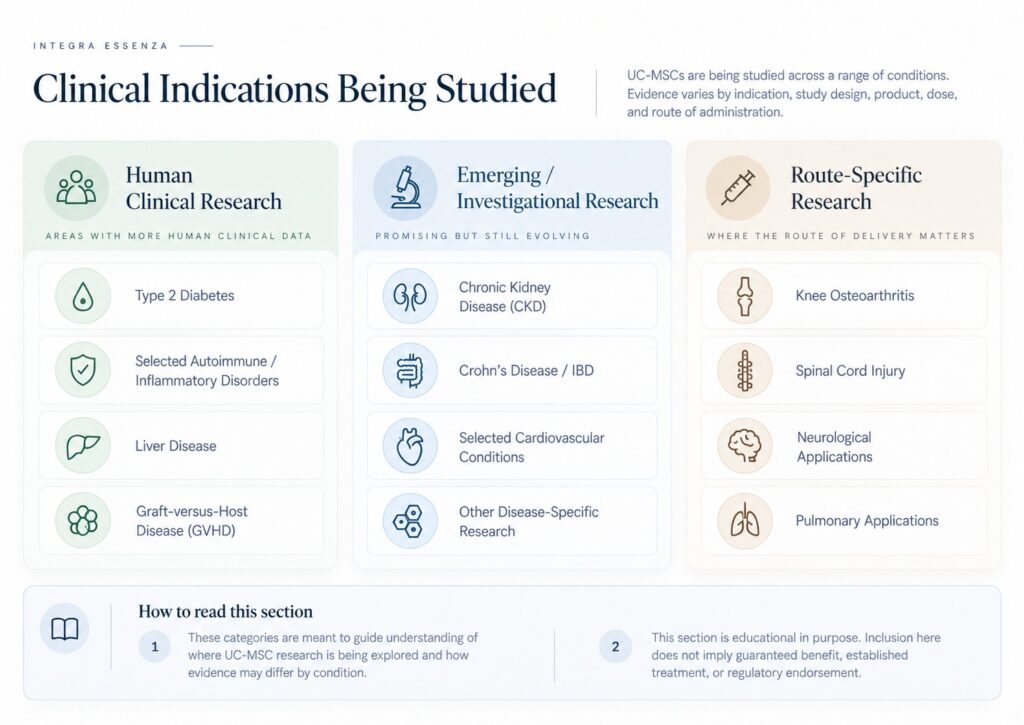
Research interest is not the same as proven clinical benefit. Our approach is to match the right patient, the right product, and the right medical reason.

Aging involves gradual changes in immune regulation, inflammatory signaling, tissue repair, vascular function, metabolism and cellular resilience. These changes do not occur in isolation—they interact with one another and may influence how the body responds to stress, illness and recovery.
One area receiving increasing scientific attention is inflammaging: the persistent, low-grade inflammatory activity that may become more common with age.
Inflammation, aging and resilience
Persistent low-grade inflammatory signaling is being studied as one contributor to age-related changes in metabolic health, immune regulation, tissue repair, vascular function, recovery capacity, and overall physical resilience.
Strength, recovery and independence
Research is exploring whether MSC-related signaling may influence pathways involved in inflammation, tissue support, recovery, and functional capacity in older adults, with emphasis on resilience rather than age reversal.
Repair, structure and resilience
Aging skin undergoes changes in collagen, elasticity, hydration, repair capacity, and inflammatory signaling. MSCs and MSC-derived factors are being studied for their potential influence on tissue-support processes.
Healthy aging should focus on function, resilience and biological understanding—not promises of age reversal.
UC-MSC therapy should not be presented as a way to stop aging, reverse biological age, make organs younger or guarantee greater energy or longevity. The appropriate question is whether a particular age-related biological or functional problem has a scientifically reasonable basis for considering cellular therapy in that individual.
Read More in the Patient Guide →
The quality of a cellular therapy does not depend on cell count alone.
For an allogeneic Wharton’s jelly MSC product, quality begins with the source tissue and donor screening, continues through controlled manufacturing and expansion, and must be maintained through testing, storage, transport, and final clinical review before administration.
At Integra Essenza, we evaluate the cellular product as part of the treatment decision—not as a commodity.

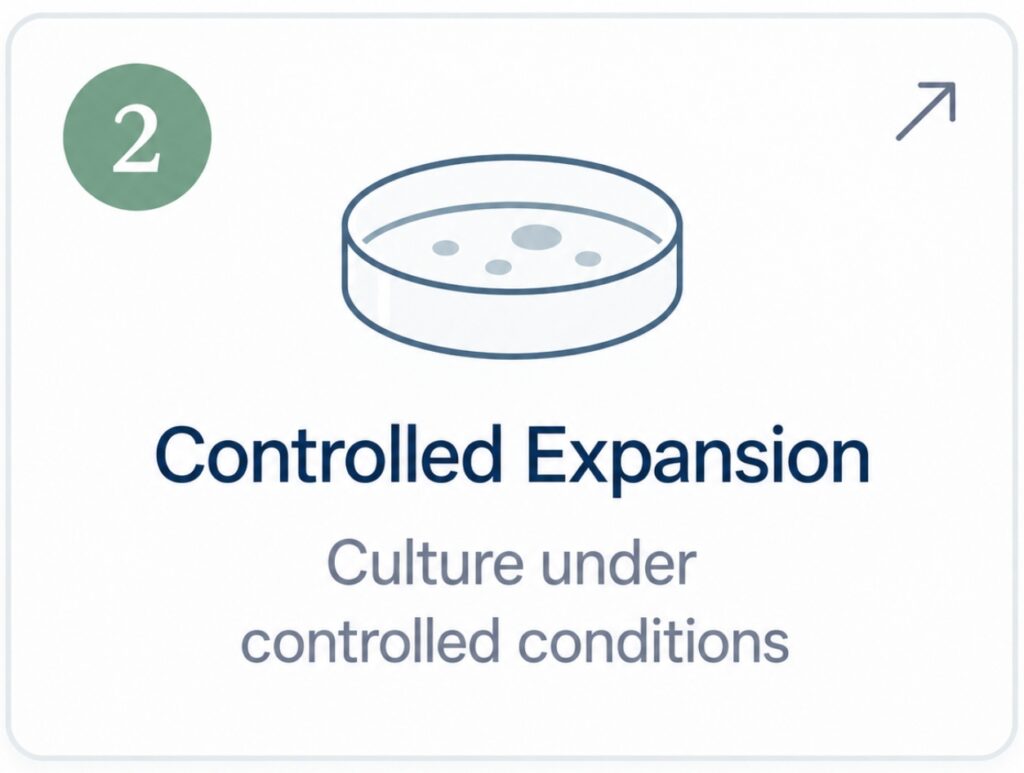










Cell number is only one part of product quality. Source, donor selection, passage, manufacturing conditions, viability, sterility, potency, storage and transport can all influence the characteristics of a cellular product.
lar product as part of the treatment decision—not as a commodity.
Read More in the Patient Guide →
UC-MSC therapy is not one treatment for everyone. Whether it should even be considered depends on the patient’s diagnosis or health objective, the biological problem being addressed, available standard treatments, the quality of human evidence, the patient’s individual risks, and the quality of the cellular product itself.






REQUEST A PHYSICIAN ASSESSMENT →Interest in stem-cell therapy does not automatically make someone a candidate.
Our goal is not to find a reason to give cells. It is to determine whether there is a reasonable scientific and medical basis to consider them for a particular patient.