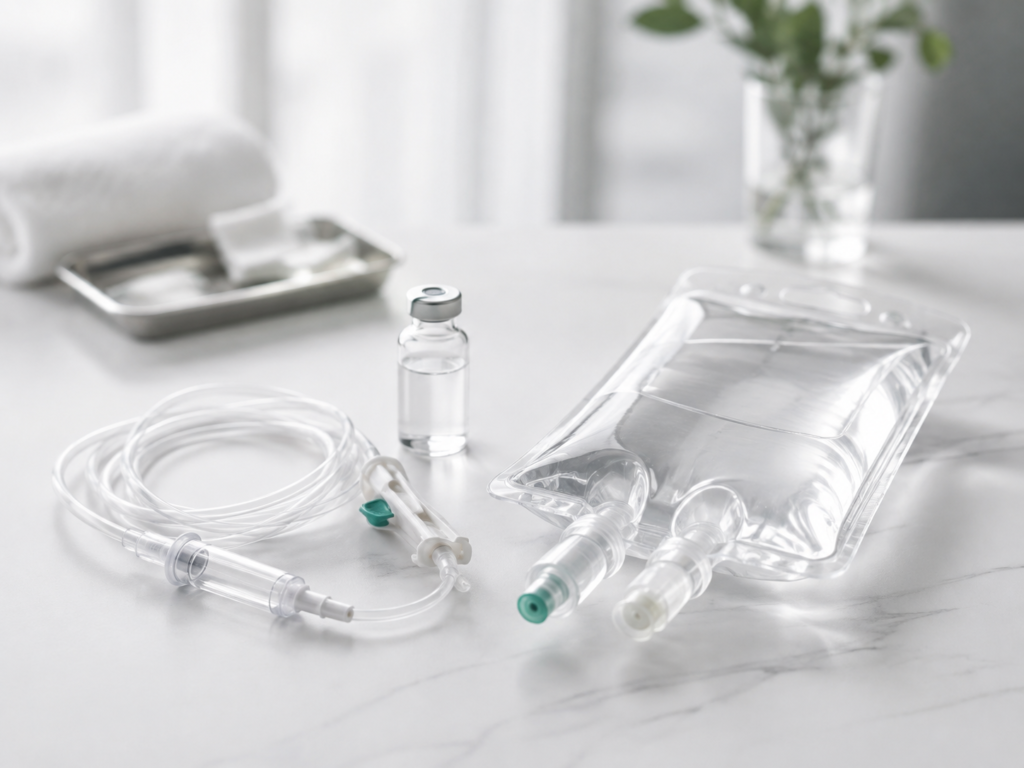
A physician-formulated hydration and micronutrient infusion for adults managing long-term kidney concerns, given alongside existing nephrology care. We’d need your current creatinine and eGFR before we start.
The Renal Care Infusion at Integra Essenza is a physician-formulated hydration, electrolyte and micronutrient infusion for adults managing long-term kidney concerns. It’s supportive care given alongside existing nephrology treatment, not a replacement for it. Current creatinine and eGFR results are required before the first session. ₱5,000 per session, assessment separate.
What this is
Someone in your life is probably managing something to do with their kidneys, and you’ve been told to be careful about what goes into their body. That instinct is right.
The Renal Care Infusion is a hydration, electrolyte and micronutrient formulation given under physician supervision in-clinic. It’s supportive care. It sits alongside whatever a nephrologist has prescribed, and it’s formulated with that prescription in front of us.
What it isn’t, said plainly: this doesn’t treat kidney disease, and it isn’t offered to improve kidney function or to change lab values. It’s not an alternative to dialysis. If your nephrologist has a management plan, that plan governs, and ours is a supportive layer a physician here decides is or isn’t appropriate on top of it.
The assessment matters more here than anywhere else on the menu. Fluid volume, electrolyte load and several common micronutrients behave differently when renal clearance is reduced. A formulation that’s unremarkable for one person can be genuinely inadvisable for another, and that judgment needs current lab values and a physician reading them.
What the session involves
1. Assessment. A physician reviews your current creatinine and eGFR, your full medication list, and your nephrology plan if you have one. If your labs are older than three months, we can run them.
2. A decision, in writing. Whether an infusion is appropriate, at what composition, and how often. Sometimes the answer is no. You receive the reasoning either way.
3. A note to your nephrologist. With your consent, we write to whoever manages your kidney care and tell them what we’re proposing.
4. Sessions, with monitoring. Roughly 60 to 90 minutes each, in-clinic, physician-supervised. Lab values are rechecked at intervals your physician sets.
Who we’d typically consider this for
There’s no list here of conditions we help with, because that isn’t a claim we’re able to make. What we can describe is who tends to be appropriate at assessment.
Adults with stable, long-managed kidney concerns already under a nephrologist’s care, who want supportive care that coordinates with it.
People whose specialist has cleared supportive hydration and micronutrient support, or is willing to be consulted.
Patients told to be careful with over-the-counter supplements, who’d rather a physician decided than guess in a pharmacy aisle.
Families arranging supportive care for a loved one, who want documentation to review and take to the treating doctor.
People who’ve had an infusion elsewhere without anyone asking to see their labs.
Who this isn’t for
You’re looking for something to replace or reduce dialysis, or to delay starting it. That’s a conversation for your nephrologist, and we’d encourage you to have it soon.
You’re in an acute episode, or your numbers have changed sharply and recently, which needs a hospital rather than a wellness clinic.
You don’t have current lab work and aren’t willing to have it done.
Your nephrologist has advised against additional infusion or supplementation, in which case their instruction stands over anything we’d propose.
You’re arranging care for someone who hasn’t agreed to it and won’t be attending.
You want a single session with no follow-up, which isn’t how this formulation is designed to work.
What’s in it
Component
Category
Balanced crystalloid base
Hydration
Electrolytes, individually dosed
Sodium, potassium, magnesium, calcium as indicated
Water-soluble vitamins
B-complex, dose adjusted for clearance
Amino acids
Where indicated by assessment
Doses and inclusions are decided by the treating physician. Nothing here is a fixed recipe.
Risks and what to expect
The risks that matter most in this group are fluid load and electrolyte shift, which is exactly why current labs are a condition of starting. Potassium in particular is something we dose against your numbers rather than a standard formula.
More generally: bruising or irritation at the cannula site, occasional light-headedness during infusion, and uncommon allergic reactions. You’ll be monitored during and after every session, and lab values are rechecked on a schedule your physician sets rather than one we sell.
Session detail
₱5,000 per session. 60 to 90 minutes plus monitoring. Cadence is set at assessment; there’s no fixed package sold on this page. Price includes physician supervision, preparation, administration and monitoring, and doesn’t include the assessment or lab work.
Where the evidence stands
Supportive hydration and micronutrient infusion for people with long-term kidney concerns is an area where the published human evidence is thinner than the marketing suggests. What’s well established is that fluid and electrolyte handling change with reduced clearance, and that some supplements accumulate. What isn’t established is that a supportive infusion changes the course of anything.
So we won’t tell you it does. What a physician here will do is decide whether a specific formulation is reasonable for you at this point, document why, and write to your nephrologist.
No. That decision belongs with your nephrologist, and we’d encourage a specialist’s view rather than a wellness clinic’s on anything to do with dialysis timing.
It depends entirely on the person and the formulation, which is why current labs are a condition of starting here. For some people the answer at assessment will be no.
We can’t answer that about a specific person outside an assessment. Bring her full medication list and current labs and a physician will give you a real answer in writing, including if that answer is no.
Usually not, since it’s supportive rather than treatment for a diagnosed condition. Separately: if you’re managing kidney care and haven’t checked whether the patient is registered in the PhilHealth Dialysis Database, that’s worth doing. It has nothing to do with us, and families sometimes lose entitlements by assuming registration is automatic.