

Essential Infusion
The broad-spectrum formulation. Vitamin C, B-complex, magnesium and calcium, in proportions a physician sets for you rather than a menu sets in advance.
5500 per session • Assessment required
BOOK AN ASSESSMENTThe Essential Infusion at Integra Essenza is a physician-formulated intravenous micronutrient infusion based on the Myers-type formulation, containing vitamin C, B-complex vitamins, magnesium and calcium in a balanced fluid base. Composition is decided by a physician after assessment. ₱5,500 per session, administered in-clinic in Alabang, Muntinlupa.
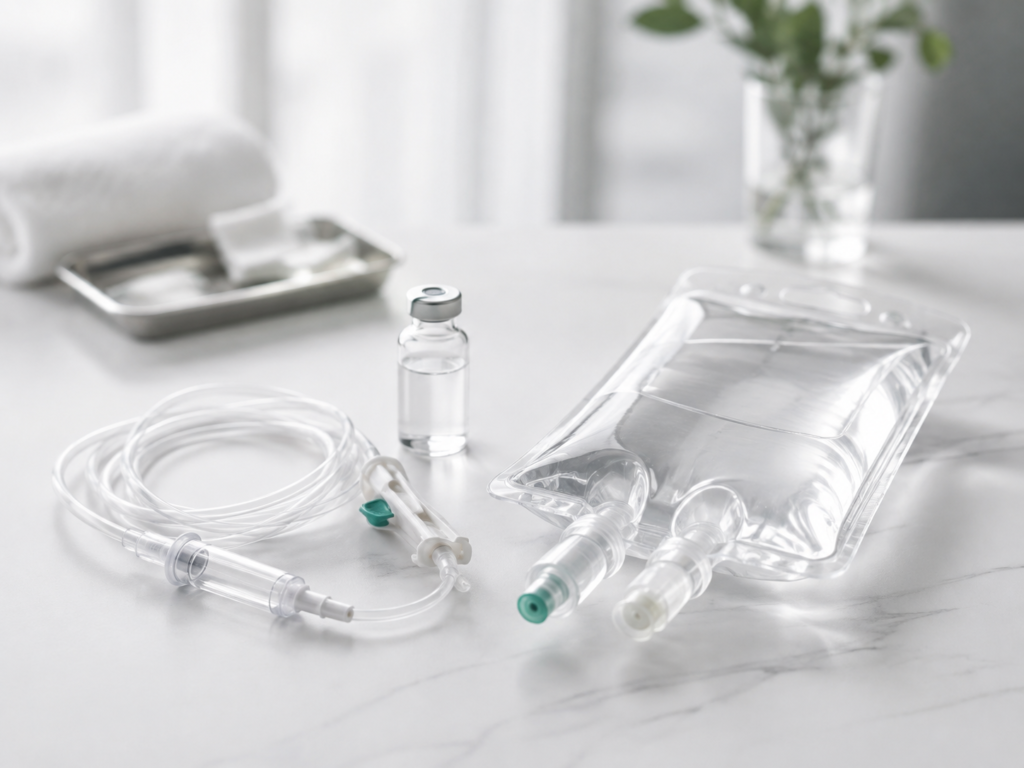
This is the formulation most people mean when they say “a vitamin drip.” It descends from what’s usually called the Myers cocktail, a combination of magnesium, calcium, B vitamins and vitamin C that’s been in clinical use in one form or another since the 1970s.
We keep it on the menu because it’s a sensible general-purpose formulation, and because a physician will sometimes look at your labs and conclude that nothing more elaborate is warranted. A patient arrives asking about the ₱8,000 recovery infusion and leaves with this one, because this is the one that fits.
What we change from the standard version is that the proportions aren’t standard. Magnesium load in particular isn’t something to give at a fixed dose to every adult, and neither is calcium. Your physician sets both against your labs and your medication list.
1. Assessment. Consultation, current labs, and your full medication and supplement list including herbal preparations.
2. Formulation. Composition and dose set for you, and written down. If a less expensive formulation is the right one, you’ll hear that in the room.
3. The session. 45 to 60 minutes in-clinic under physician supervision, with monitoring after.
4. Written findings. What was reviewed, what was decided, what it cost, and whether a repeat is recommended.
| Component | Category |
|---|---|
| Balanced fluid base | Hydration |
| Ascorbic acid | Water-soluble vitamin, dose per assessment |
| B-complex | Water-soluble vitamins |
| Magnesium | Electrolyte, dose per assessment |
| Calcium | Electrolyte, dose per assessment |
The most common experience is a warm flushing sensation and sometimes a metallic taste during infusion, both related to magnesium and to rate. Slowing the infusion usually settles it.
Beyond that: bruising or irritation at the cannula site, occasional light-headedness, and uncommon allergic reactions. Magnesium and calcium both need care in anyone with a cardiac or renal history, which is why the assessment asks about both.
₱5,500 per session, 45 to 60 minutes plus monitoring. Includes physician supervision, preparation, administration and monitoring. Assessment and lab work are separate and aren’t credited against the session.
The Myers-type formulation has been used clinically for decades and has a reasonable safety record when dosed properly under supervision. The published evidence that it produces measurable benefit in generally healthy, well-nourished adults is limited, and much of what exists is small or uncontrolled.
Intravenous micronutrients have a clearer rationale when there’s an actual deficit or an absorption problem, which is one of the things the assessment looks for.
Click here if you’re arranging this for someone else
More components and a longer session. Your physician may still recommend the less expensive one.
Where there’s a documented deficit or absorption problem, replacement has a clear rationale. In a well-nourished adult the evidence is thin, and the assessment is how you find out which applies to you.
Most commonly warmth or flushing during infusion from the magnesium, occasionally a metallic taste, and cannula-site irritation. Allergic reactions are uncommon.
Some people report feeling better afterwards and some don’t. It isn’t something we can promise or measure for you in advance.
Cadence is set at assessment and reviewed. There’s no standing weekly schedule on offer.
You can tell us what you’re hoping to address, and a physician decides the composition.
Yes, current labs including renal function.
Yes, and please do. Come hydrated as well.