
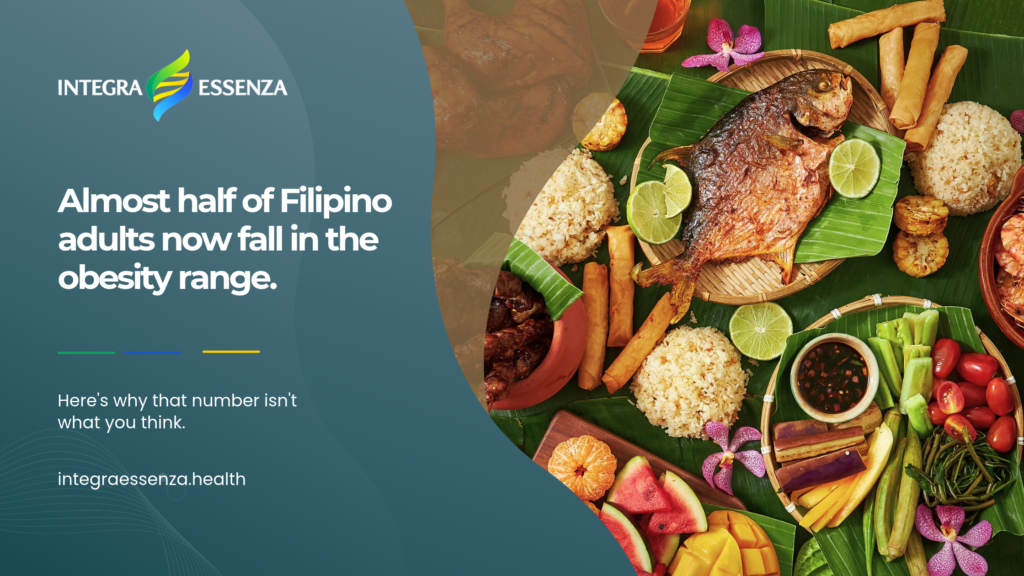
That’s the headline finding of the 2025 Updating Survey by the Department of Science and Technology’s Food and Nutrition Research Institute (DOST-FNRI). Among adults aged 20 to 59, the share in the obesity range rose from 39.8% in 2023 to 44.5% in 2025.
It’s a number that’s easy to share and easy to misread, mostly because of one detail in how it was measured. Here’s what the survey actually measured, where the numbers are highest, and what’s realistic to do with it.
How many Filipino adults are in the obesity range?
According to FNRI, 44.5% of Filipino adults aged 20 to 59 were classified as obese in 2025, nearly five percentage points higher than the 2023 National Nutrition Survey. Another 17.1%, about two in ten adults, were classified as overweight, as reported by BusinessWorld.
The National Nutrition Council noted that overweight and obesity worsened across nearly all age groups between 2023 and 2025, falling short of the reduction targets in the Philippine Plan of Action for Nutrition 2023 to 2028.
Why does the number seem so high?
Because the survey uses the Asia-Pacific BMI classification, not the global one.
Body mass index (BMI) is your weight in kilograms divided by your height in meters, squared. Under the global WHO classification, obesity starts at a BMI of 30. Under the Asia-Pacific classification used by FNRI, obesity starts at 25, and overweight at 23 to 24.9. The lower cutoffs exist because Asian populations tend to face health risks at lower body weights than the populations the global cutoffs were based on.
So a Filipino adult with a BMI of 26 would be counted as “overweight” in many Western reports, and as “obese” in this one. That’s worth knowing before you compare these figures with numbers from other countries, and before you draw conclusions about yourself.
BMI is also a screening measure, not a diagnosis. It doesn’t distinguish muscle from fat, and it says nothing about where weight is carried or how your labs look. It’s a starting point for a conversation with a physician, nothing more.
Who is most affected?
The survey found the highest obesity prevalence among three groups, according to Rappler’s report on the FNRI findings:
- Women: 50.1%
- Urban residents: 48.3%
- Adults in the wealthiest households: 57.8%
The last figure surprises many people. FNRI data showed that as households gain more means to buy food, obesity becomes more common, and regions with larger urban populations tended to have higher rates, Rappler noted.
For families in Metro Manila and nearby cities like Muntinlupa, Las Piñas, Bacoor, and Santa Rosa, this is the group the data points to: urban, busy, and with more food choices than ever.
What does the survey say is driving it?
FNRI pointed to persistent behavioral risk factors: physical inactivity, smoking, and alcohol use. The National Nutrition Council added rapidly shifting dietary patterns and more sedentary daily lives, in what it called an increasingly obesogenic environment, meaning surroundings that make high-calorie food easy and movement optional.
FNRI researchers also made a point that’s worth repeating at every family table: eating a lot isn’t the same as eating well. A plate can be full and still be short on what the body needs.
The picture for younger Filipinos is moving in the same direction. Physical inactivity among adolescents aged 10 to 19 rose from 75.5% in 2023 to 77.5% in 2025.
What can you do with this information?
National numbers describe a population. They don’t describe you. But the habits behind them are the same ones most of us can work on, and none of them require a gym membership or a special diet.
Fill half your plate with vegetables and fruit. The FNRI’s Pinggang Pinoy puts vegetables and fruit on half the plate, rice and other Go foods on about a third, and fish, meat, eggs or beans on about a sixth.
Count minutes of movement. The WHO recommends 150 to 300 minutes of moderate activity a week for adults, and says some activity is better than none. A brisk 30-minute walk five days a week reaches the lower end. Housework, walking to places and taking the stairs all count.
Watch the drinks. WHO recommends keeping free sugars under 10% of daily energy, ideally under 5%. A single can of soda can contain up to about 10 teaspoons. Water on the table at every meal is an easy default.
Protect your sleep. Adults are recommended at least seven hours a night. Short sleep makes everything else harder to keep up.
Know your own starting point. The most useful number isn’t the national one. It’s yours: your history, your recent labs, and how your weeks actually go.
Frequently asked questions
What BMI counts as obese in the Philippines?
FNRI uses the Asia-Pacific classification, where a BMI of 25 or higher is classified as obese, and 23 to 24.9 as overweight.
When was the 2025 FNRI survey conducted?
The 2025 Updating Survey ran from April 2025 to March 2026, through face-to-face interviews in sample households across 118 areas of the country.
Why do wealthier Filipinos have higher obesity rates?
FNRI data shows obesity becomes more common as households gain more means to buy food. Urban living, more processed and restaurant food, and less daily physical activity are part of the picture.
Is BMI enough to know if my weight is a health concern?
No. BMI is a screening tool. A physician looks at it alongside your health history, waist measurement, lab results, and lifestyle before drawing any conclusions.
This article is for educational purposes only and does not replace medical advice. Speak with your licensed physician about weight management options suited to your health history.
Integra Essenza works alongside existing medical care. If you’d like a physician to look at your own history and numbers, that conversation starts with an assessment.
